
Introduction
Smartphones have become an essential part of our daily lives. From waking us up in the morning to helping us work, learn, communicate, shop, and even navigate the world, these small devices play a huge role in modern society. While most people use smartphones every day, very few truly understand the complex technology working silently behind the screen.
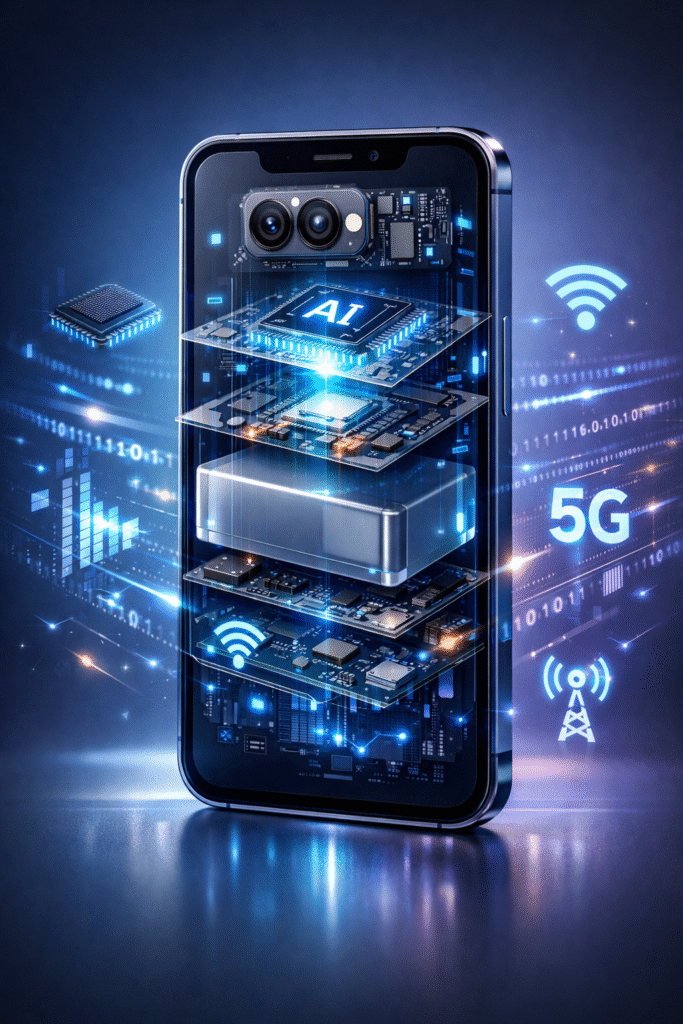
A smartphone is not just a phone. It is a powerful computer, a communication device, a camera, a GPS navigator, a payment wallet, and a mini entertainment center — all combined into a slim piece of hardware that fits in your pocket. Behind this convenience lies years of innovation in hardware engineering, software development, networking, and artificial intelligence.
In this article, we will explore the core technologies behind smartphones, explaining how they work in simple terms. This guide is designed for everyday readers, tech enthusiasts, and website owners looking for high-quality, original content suitable for Google AdSense approval.
1. The Brain of a Smartphone: The Processor (SoC)
At the heart of every smartphone is the System on a Chip (SoC). This is the main processor that controls almost everything the phone does.
What Is an SoC?
An SoC combines several important components into one chip, including:
- CPU (Central Processing Unit) – handles general tasks and calculations
- GPU (Graphics Processing Unit) – manages graphics, games, and videos
- AI Engine (NPU) – processes artificial intelligence tasks
- Modem – connects the phone to mobile networks
Popular smartphone processors include Qualcomm Snapdragon, Apple A-series, MediaTek Dimensity, and Samsung Exynos.
Why Processors Matter
The processor determines:
- Phone speed and performance
- Gaming experience
- Battery efficiency
- Camera processing quality
Modern processors use advanced manufacturing technology like 4nm or 3nm, which allows more power with less energy consumption.
2. Operating Systems: The Software That Brings Phones to Life
Hardware alone is useless without software. The operating system (OS) is what allows users to interact with their smartphones.
Major Smartphone Operating Systems
- Android – Used by Samsung, Xiaomi, Tecno, Infinix, and many others
- iOS – Exclusively for Apple iPhones
What the OS Does
The operating system:
- Manages hardware resources
- Runs apps smoothly
- Controls security and permissions
- Handles updates and background tasks
Android is known for customization and flexibility, while iOS focuses on stability, privacy, and seamless integration with Apple devices.
3. Touchscreen Technology: How Your Phone Feels Your Fingers
One of the most important smartphone technologies is the touchscreen.
Capacitive Touchscreens
Modern smartphones use capacitive touchscreens, which detect electrical signals from your fingers. When you touch the screen, it changes the electrical field, and the phone knows exactly where you touched.
Display Types
Smartphones use different display technologies, including:
- LCD (Liquid Crystal Display)
- OLED (Organic Light Emitting Diode)
- AMOLED (Advanced OLED)
OLED and AMOLED displays offer:
- Deeper blacks
- Better contrast
- Lower power consumption
High refresh rates like 90Hz, 120Hz, or even 144Hz make scrolling and animations smoother.
4. Camera Technology: More Than Just Megapixels
Smartphone cameras have evolved rapidly, sometimes competing with professional cameras.
Camera Hardware
A smartphone camera includes:
- Image sensor
- Lens system
- Optical image stabilization (OIS)
- Autofocus mechanisms
Computational Photography
The real magic happens in software. Smartphones use computational photography, where AI improves photos by:
- Enhancing details
- Reducing noise
- Improving low-light shots
- Creating portrait blur effects
Features like Night Mode, HDR, and AI Scene Detection rely heavily on software rather than hardware alone.
5. Battery Technology and Power Management
Battery life is one of the biggest concerns for smartphone users.
Lithium-Ion and Lithium-Polymer Batteries
Most smartphones use Lithium-Ion (Li-ion) or Lithium-Polymer (Li-Po) batteries because they are:
- Lightweight
- Rechargeable
- Energy-dense
Fast Charging Technology
Modern phones support fast charging technologies such as:
- USB Power Delivery (USB-PD)
- Qualcomm Quick Charge
- Proprietary fast charging systems
Some phones now charge from 0% to 50% in under 20 minutes.
Smart Power Management
Software plays a key role by:
- Limiting background apps
- Learning user habits
- Optimizing CPU performance
This helps extend battery life even with smaller battery sizes.
6. Mobile Network Technology: How Smartphones Stay Connected
Smartphones rely on advanced network technology to communicate.
Mobile Network Generations
- 2G – Calls and SMS
- 3G – Basic internet access
- 4G LTE – Fast internet, video streaming
- 5G – Ultra-fast speeds, low latency
What 5G Brings
5G technology enables:
- Faster downloads
- Smoother video calls
- Better online gaming
- Support for smart cities and IoT devices
Smartphones also support Wi-Fi 6, Bluetooth, and NFC for short-range communication.
7. Sensors: The Hidden Technology Inside Smartphones
Smartphones are packed with sensors that improve user experience.
Common Smartphone Sensors
- Accelerometer – detects movement and screen rotation
- Gyroscope – improves motion sensing
- Proximity sensor – turns off screen during calls
- Fingerprint sensor – biometric security
- Face recognition sensors – facial authentication
These sensors work together to enable features like fitness tracking, gaming controls, navigation, and security.
8. Artificial Intelligence and Machine Learning
AI has become a core part of modern smartphones.
How AI Is Used
Smartphones use AI for:
- Camera improvements
- Voice assistants (Google Assistant, Siri)
- Predictive text and autocorrect
- App optimization
- Fraud detection and security
On-device AI ensures faster processing and better privacy, as data does not always need to be sent to the cloud.
9. Storage and Memory Technology
RAM (Random Access Memory)
RAM affects how many apps your phone can run smoothly at the same time. Modern smartphones now offer:
- 6GB, 8GB, 12GB, or even 16GB RAM
Internal Storage
Storage uses UFS (Universal Flash Storage) technology, which is much faster than older eMMC storage. Faster storage means:
- Quicker app loading
- Faster file transfers
- Smoother overall performance
10. Security and Privacy Technology
Security is critical in smartphones due to personal data.
Security Features
- Biometric authentication
- Secure enclaves in processors
- Encrypted storage
- Regular software updates
Modern smartphones are designed to protect user data from malware, hacking, and unauthorized access.
The Future of Smartphone Technology
Smartphone technology continues to evolve. Future innovations may include:
- Foldable and rollable displays
- Satellite communication
- More powerful AI capabilities
- Better battery technology
- Enhanced augmented reality (AR)
As smartphones become smarter, they will continue to replace many traditional devices.
Conclusion
Smartphones are one of the most complex consumer technologies ever created. Behind their sleek designs lies a powerful combination of advanced processors, intelligent software, high-speed networks, AI, sensors, and energy-efficient hardware.
Understanding the technology behind smartphones helps us appreciate how far innovation has come and where it is heading. These devices are no longer just tools for communication — they are essential digital companions shaping how we live, work, and connect with the world.
As smartphone technology continues to advance, one thing is certain: the future will be even more connected, intelligent, and mobile.