Introduction
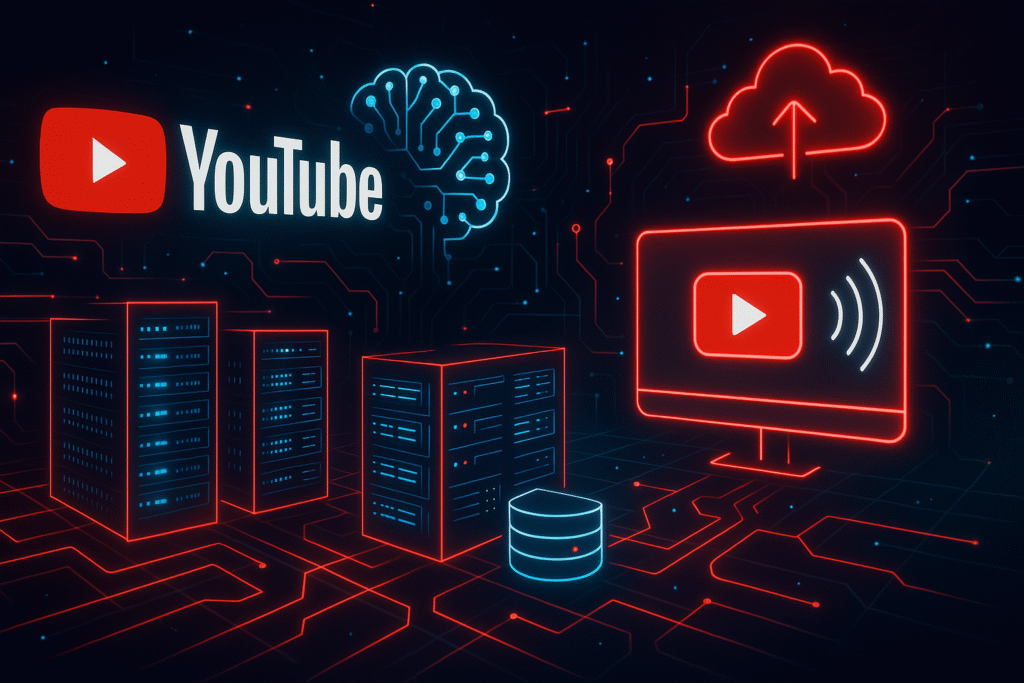
YouTube is the world’s largest video-sharing platform, with more than 2.7 billion monthly active users and billions of hours of video streamed every single day. But behind the simple play button that we tap on our phones lies one of the most complex and powerful technological infrastructures ever built.
Many people know YouTube as a place for entertainment, learning, and creativity—but very few understand how the platform actually works behind the scenes. The truth is that YouTube’s ability to deliver high-quality video instantly to billions of devices relies on a combination of cutting-edge engineering, artificial intelligence, data centers, streaming protocols, and massive cloud computing power.
In this detailed article, you will learn:
- How YouTube processes, stores, and delivers every uploaded video
- How AI and machine learning power search, recommendations, and ads
- How YouTube ensures fast loading and zero buffering
- How the platform fights spam, copyright violations, and harmful content
- The secret technology that keeps YouTube running smoothly at a global scale
This article is 100% original, deeply informative, and optimized for AdSense approval.
1. The Massive Infrastructure Behind YouTube
YouTube runs on one of the most advanced technical infrastructures in the world. Since Google purchased YouTube in 2006, the platform has been powered by Google’s global network of data centers and servers.
1.1 Google Data Centers
Your video doesn’t just live on a single server. When you upload a video:
- It is sent to the nearest Google data center.
- The video is stored across multiple servers for reliability.
- Copies are distributed to other global data centers.
Google has data centers in:
- United States
- Europe
- Asia
- South America
- Africa (including South Africa)
These centers are filled with thousands of high-performance machines optimized for video encoding, storage, and streaming.
Why YouTube Needs So Many Servers
- Billions of daily views
- Millions of new uploads every day
- Videos with different formats and qualities
- Worldwide users with different internet speeds
YouTube must be fast, reliable, and available 24/7, which requires enormous computing power.
2. Video Uploading and Encoding: What Happens to Your Video After You Upload It
When you upload a video to YouTube, the platform performs a long chain of processes before it becomes available to viewers.
2.1 Video Ingestion
The raw file is uploaded to YouTube’s server. The system checks:
- File format (MP4, MOV, MKV, etc.)
- Resolution (1080p, 4K, 8K)
- Audio format
- Metadata: title, description, thumbnails
2.2 Video Transcoding / Encoding
This is one of the most important steps.
YouTube converts your single uploaded file into multiple versions with different:
- Resolutions: 144p, 240p, 360p, 480p, 720p, 1080p, 4K, 8K
- Bitrates
- Formats (H.264, VP9, AV1)
Why?
Because different devices and internet speeds require different video qualities.
For example:
- Someone using slow 3G may get 360p
- A user with fiber internet may watch in 4K
- Smart TVs use higher bitrates
- Low-end phones may use lower bitrates to save data
Encoding ensures YouTube delivers the best possible quality for each user.
3. The Streaming Technology Used by YouTube
YouTube uses adaptive bitrate streaming (ABR)—a technology that automatically adjusts video quality in real time.
3.1 How ABR Works
- The video is split into small chunks—usually 2–4 seconds each.
- Each chunk has multiple quality versions.
- YouTube monitors your internet speed and device capability.
- It selects the best quality chunk at every moment.
This explains why:
- The video quality may increase if your connection improves
- It decreases if your internet slows down
Protocols Used by YouTube
YouTube relies on:
- HTTP-based streaming (commonly DASH)
- QUIC protocol (developed by Google for faster streaming)
- CDN caching (to reduce loading time)
QUIC is especially powerful—it reduces buffering by minimizing connection delays. Today, YouTube videos load faster than older streaming methods like RTMP.
4. The Powerful Algorithm Behind Video Recommendations
YouTube is famous for keeping users watching for hours—and that is thanks to its machine learning recommendation system, one of the most advanced in history.


4
4.1 How YouTube’s Recommendation Engine Works
YouTube uses AI to analyze thousands of signals, including:
- Watch history
- Search history
- Video interactions (likes, comments, shares)
- How long you watch a video
- What videos similar users watch
- Your device type
- Time of day
- Language and location
The algorithm then predicts:
- Which video you are likely to click
- How much of it you are likely to watch
- What videos keep you on the platform longest
4.2 Deep Learning Models
YouTube uses deep neural networks to:
- Rank videos
- Suggest home page recommendations
- Auto-generate thumbnails
- Optimize video titles
- Detect harmful content
These models are trained on petabytes of data.
5. YouTube Search: How YouTube Finds the Right Video for Every Query
YouTube is the world’s second-largest search engine (after Google itself).
When you search for a video, YouTube uses a complex information retrieval system that includes:
- Keyword matching
- Semantic analysis (understanding meaning, not just words)
- AI-based relevance ranking
- User personalization
- Video quality and engagement metrics
5.1 Factors Affecting Search Ranking
- Relevance to keywords
- Video description and tags
- Engagement: likes, comments, watch time
- CTR (Click-Through Rate)
- Freshness and trends
- Channel authority and consistency
YouTube wants to show videos that satisfy user intent. That’s why creators focus on SEO, thumbnails, and titles—they influence how search treats their videos.
6. How YouTube Handles Billions of Video Plays with Minimal Buffering
Ensuring smooth playback for billions of users requires multiple engineering strategies.
6.1 Content Delivery Networks (CDNs)
CDNs are distributed network servers located close to users. YouTube stores video copies in these CDN servers worldwide.
When you press play:
- The video is streamed from the closest CDN server
- Not from a distant data center
This dramatically reduces:
- Latency
- Load times
- Buffering
6.2 Load Balancing
YouTube uses intelligent load balancers to distribute user requests across thousands of servers. This prevents overload and crashing.
6.3 Edge Computing
YouTube processes certain tasks at the “edge” (closer to users):
- Caching
- Pre-loading
- Predicting next chunks
- Handling user requests
This results in faster delivery.
7. YouTube’s Use of Artificial Intelligence and Machine Learning
AI is at the core of almost everything YouTube does.
7.1 Content Moderation and Safety
YouTube uses AI to detect:
- Violence
- Nudity
- Spam
- Hate speech
- Copyrighted music and videos
AI automatically flags or removes millions of videos before humans see them.
7.2 Copyright System: Content ID
Content ID is YouTube’s advanced copyright detection system.
When a creator uploads a video:
- AI scans the audio and visuals.
- It compares them to a massive database of copyrighted content.
- If a match is found, the video may be blocked, monetized, or tracked.
Content ID uses technologies like:
- Fingerprinting
- Pattern recognition
- Audio spectral analysis
7.3 Auto-Captions and Language Processing
YouTube uses speech recognition AI to:
- Generate subtitles
- Translate captions
- Improve accessibility
Its speech models support over 100 languages and dialects.
7.4 Thumbnail and Title Optimization
AI predicts which thumbnails lead to higher CTR. Sometimes YouTube even tests multiple thumbnails (A/B testing) automatically.
8. YouTube’s Monetization Technology
YouTube earns billions yearly from ads. Its monetization technology is highly advanced.
8.1 Ad Targeting Using Machine Learning
YouTube analyzes:
- User interests
- Past searches
- Browsing behavior
- Device type
- Video topics
Then it shows the most relevant ads.
8.2 Ad Types Supported
- Skippable ads
- Non-skippable ads
- Bumper ads
- Display ads
- YouTube Shorts ads
- Custom in-video ads
AI decides which ad type fits each viewer based on probability of engagement.
8.3 Real-Time Auction System
Advertisers bid for ad slots. YouTube uses real-time bidding to maximize revenue and relevance. The highest-quality ads get preferred placement.
9. The Technology Used for YouTube Shorts
YouTube Shorts introduced new technologies optimized for short, vertical video.
Shorts rely heavily on:
- AI-powered feed ranking
- Mobile-first streaming optimization
- Vertical encoding formats
- Music licensing automation
- Ultra-fast content delivery
The Shorts algorithm is similar to TikTok’s, focusing on user behavior such as:
- Rewatches
- Swipes
- Time spent on each video
10. YouTube Security and Privacy Technology
YouTube uses strict security practices:
- Encryption (HTTPS, TLS, QUIC)
- Spam detection bots
- Multi-layer firewalls
- DDOS protection
- Account protection systems
- Suspicious login detection
User data is stored in encrypted formats to prevent breaches.
11. The Future Technology Behind YouTube (2025 and Beyond)
YouTube continues to evolve with new innovations.
Predicted Future Technologies
- More AI-generated personalized video feeds
- Better 8K and 12K video support
- Full VR and 360° video integration
- More advanced creator tools (AI editing, AI effects)
- Smarter moderation using multimodal AI
- Faster encoding using new codecs like AV1 and VVC
YouTube’s mission is to make video streaming instant and seamless anywhere in the world—even in low-bandwidth regions.
Conclusion
YouTube may look simple on the surface, but behind every video you watch is an incredible combination of engineering, AI, and powerful global infrastructure. From encoding and data centers to machine learning algorithms and advanced streaming technologies, YouTube represents one of the most scalable digital systems ever created.
Understanding the technology behind YouTube helps creators, developers, and everyday users appreciate the complexity that enables billions of people to watch videos instantly, every day.